Rhetorical analysis of “10 easy ways you can tell for yourself that the Earth is not flat” by Moriel Schottlender
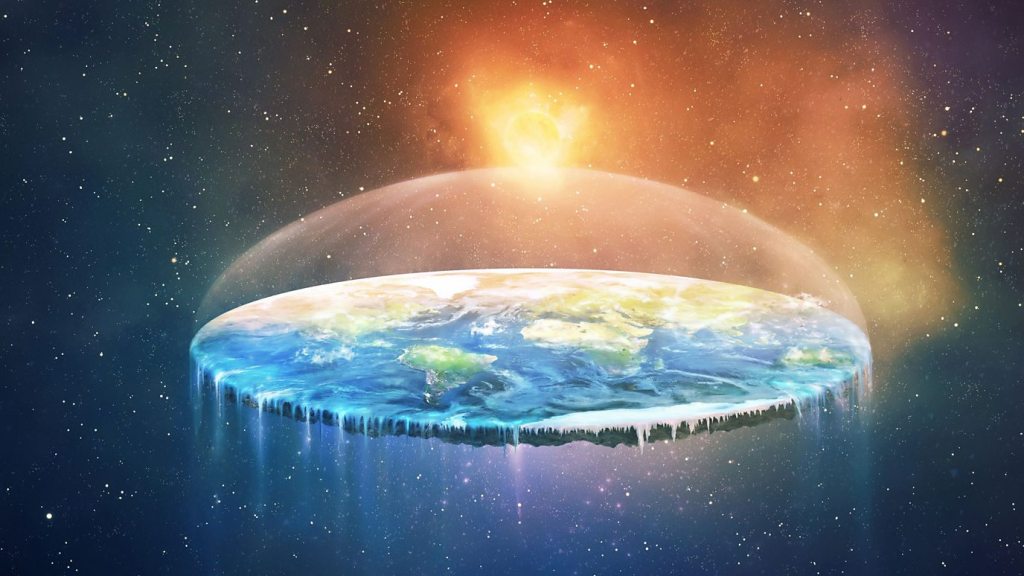
In recent years, the Flat Earth Society has evolved significantly and attracted more and more people to believe that the Earth is flat, including some celebrities like NBA star Kyrie Irving or rapper B.o.B. There are numerous rebuttals against the belief of this group, and complex scientific experiments were conducted to prove that the Earth is round. However, when moving to the article “10 easy ways you can tell for yourself that the Earth is not flat”, published by Moriel Schottlender, we can find the author’s different attitude towards the Flat Earth Society and her persuasive ways to prove the Earth is spherical by using rhetorical methods, which are pathos and logos.
First, let’s have a brief look at the author’s background. “Schottlender is a senior software engineer at Wikimedia Foundation, the nonprofit that runs Wikipedia” (Alumni Spotlight). She received her Bachelor’s degree in Physics at CUNY City College and a Master’s degree in Computer Science at New York Institute of Technology. Therefore, her knowledge of physics and astronomy is credible, and by ethos, her arguments in this article should initially earn the credentials.
Pathos is interestingly used in her article. In the introduction, the way that she approaches some beliefs of the Flat Earth Society is intriguing and appealing. At first, she claims that the idea of the round Earth “existed for a few millennia” and agrees with Phil Plait, an astronomer, that it is not worth it to have a debate about the shape of the Earth with people in the Flat Earth Society. (Schottlender) She believes that everyone should just base on obvious phenomena to find out the answer of whether the Earth is flat or round rather than wasting their time on meaningless arguments. She also strongly states that the Earth is “unequivocally, absolutely, positively, 100% not flat!” (Schottlender). During talking about 10 factors, her word choice makes readers feel that the spherical Earth is easily proved by saying “we don’t just suspect that our planet is spherical. We know it”, “absolutely, utterly”, “it’s also obvious why they take this shape”(Schottlender). When discussing about a problem, she often includes the word “we” in order to earn the collaboration and create an assumption that everyone should know about it. In addition, the term “not flat” was repeated a thousand times to strongly remind the readers of the point that she believes.
In a scientific article, logos is definitely the method that is used most, and Schottlender uses it reasonably and comprehensively in her arguments. She impliedly separates the factors into three parts: the two first are about physical, the three next are about optical and the five last are about logical and personal experience. The first factor that the author uses for her argument is the moon, which has an extremely close relationship to the Earth. She based on observations that when the Earth is directly between the moon and the Sun, “the shadow on the moon’s surface is round.” (Schottlender) This observation was conducted by Aristotle, who was an expert in the astronomy field and had made a bunch of experiments relating to determining the shape of the Earth. The author’s art of choosing the references which have a bonding connection to the field that she argues makes her opinions more persuasive and reasonable through logos. The next factor to me is the most interesting thing in this article when the author uses just basic logical thinking about “Ships and the horizon” to prove that the Earth is round. (Schottlender) She gives us two very familiar examples, which are ship-sea and ant-orange. She explains that if the Earth is flat, a ship should “just appear out of the horizon” rather than “emerging from beneath the sea.” (Schottlender) To be more specific, the author uses the images of an ant when moving on the orange’s surface, which is exactly similar to those of the ship.
The three next factors are about the optics knowledge applied to explain why the Earth is round. Three pieces of evidence she gives us are about the “star constellations”, “shadows and stricks”, and “seeing a tree from farther and higher.” (Schottlender) In all these experiments, she points out unrealistic things if the Earth was flat and the phenomena that we often witness in these three situations could only occur if the Earth is round. The way she denies the belief of the Flat Earth Society is not offensive but very straight and reasonable. All her arguments are supported by optics knowledge, which is really obvious and persuasive. She also includes some pictures in both cases: when the Earth is flat or round. Her way of using logos is reasonable when arguing something about science or nature, but her writing is not hard to understand because she uses familiar examples or words when approaching the scientific issues.
The next examples that Schottlender uses to persuade the reader to believe in the spherical Earth are based on logical and personal experience. The first example is when we are “sitting on a plane” and “looking out the window”, we will see the curvature of the Earth on the horizon. (Schottlender) This example leads readers to the most simple and easiest way to determine the shape of the Earth, which is observing it from above. Let’s move to the next method, which is comparing the Earth to other planets in the universe. This way requires readers to have logical thinking about the fact that all planets should have some identical characteristics and similar shapes. The author refers to the finding of Galileo that people could observe the shape of other planets like Jupiter, Neptune or Venus to be spherical. In addition, she also disproves that the idea of the Flat Earth is inverse to “how planets form and behave.” (Schottlender). We can see that she is really enthusiastic about her points through her word choice and shows obvious proof that everyone should know and understand logically. Additionally, she also gives us evidence about time zones and explicitly states that this phenomenon just occurs “if the world is round, and rotating its own axis.” (Schottlender) Finally, she shows us a photo about the spherical shape of the Earth, which was captured by ISS Commander Scott Kelly’s Instagram and concludes by a very persuasive, undeniable quote: “a picture is worth a thousand diss tracks.” (Schottlender)
Throughout the article, Schottlender convinces readers by showing different ways to prove the spherical shape of the Earth from various scientific approaches such as physics, optics, logical and personal experience. Indeed, these ways are very familiar and easy to understand, even to people with basic knowledge about the nature and surroundings. In addition, her arguments are really explicit, reasonable and strong. Her use of logos is strongly emphasized in this article besides pathos because she argues about the scientific problem. For every proof, she always explains why the idea of the Flat Earth is wrong and unrealistic, which helps her opinions be more persuasive. However, she does not include her background or any involvements in terms of physics or aerospace in this article. I suppose that the lack of ethos is the only thing that she needs to consider and improve in the following articles.
In conclusion, “10 easy ways you can tell for yourself that the Earth is not flat” is a good article where Schottlender comprehensively uses rhetorical methods such as pathos and logos to persuade readers to believe that the Earth is spherical. Throughout the article, all her ideas and arguments are expressed in a clear, logical way with strong, reasonable word choice and tone. This article will be an interesting and attractive source for everyone regardless of his knowledge about astronomy or aerospace.
Works Cited
Schottlender, Moriel. “10 easy ways you can tell for yourself that the Earth is not flat.” Popular Science, 26 Jan. 2016, www.popsci.com/10-ways-you-can-prove-earth-is-round/?fbclid=IwAR1c7QexU_PXJY-OZYOk-1k45xqnJzAOOec9vhjLxqGVjwNvQCAu54aP9Lw
“Alumni Spotlight” Society of Physics Students, Summer 2017, www.spsnational.org/the-sps-observer/summer/2017/moriel-schottlender
Reflection
Once again, this inquiry continues allowing me to write about the thing that I am really interested in, which is aerospace. I feel free to find, analyze information about this topic and express my opinions. Space is a very broad topic that human does not know about it, so debates around it is very appealing because we can hear different opinions and arguments. This inquiry helps me learn various rhetorical methods, and analyze how authors use these methods in their articles. I think I did well in analyzing the author’s use of logos in her article. However, I encounter struggles when organizing my essay like sometimes I coincidentally include my analysis of pathos in the logos’s paragraph. Actually, at first, I did not know whether I should analyze the article towards its structure with the mix of analysis of rhetorical methods or separating these methods and talking about how each of them influences on the article as a whole. Then, I came to the Writing center and the librarian said that I should follow the second one. I think the best part of this assignment is still about freely choosing the topic that I said above. In addition, I also like the way the professor guides us to approach this assignments, which is from very small, simple steps.
 Hieu's Blog